Among the modern solar compasses used during the Second World War, it is undoubtedly the simplest and most effective model for this purpose.
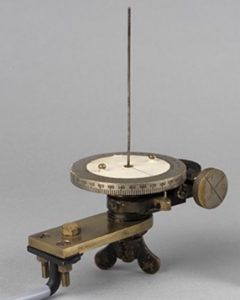
It is a graduated disc, crossed by a gnomon in its center. It is used with a correspondence table that gives the azimuth of the Sun for the date and time of the observation (at the given latitude). The disk is oriented so that the shadow of the gnomon corresponds to the azimuth of the moment of observation. The 0°-180° axis then indicates the North-South axis.
The Bagnold compass was used by the British Special Forces, in particular the Long Range Desert Group (LRGD), who became famous for daring actions behind enemy lines. LRDG’s ability to navigate the desert was essential. Made even more famous today by the (free) interpretation given by the series “Rogue Heroes” (2022).
Note that the gnomon is very long, so that its shadow can reach the end of the disk (where the survey will be taken), even if the Sun is very high – which is common at these latitudes.
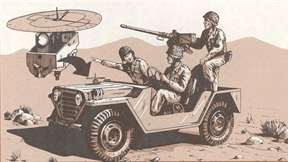
This Bagnold compass has the advantage of being able to be used while the vehicle is in motion: you are not trying to read the end of the gnomon’s shadow, but just its direction. This advantage allows you to keep a diary and note how long you have driven in which direction, at what speed. At the end of the day, we therefore have additional information on its position (equivalent to sailing by esteem in maritime navigation).
Another fairly simple sun compass is the “Cole Universal Sun Compass Mk3”, which seems to have been used until the sixties by the French forces in North Africa.
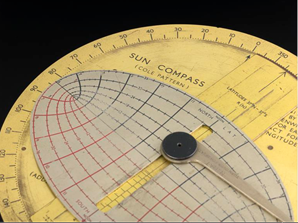
Cole Universal Sun Compass Mk3