Finding the North without a Compass
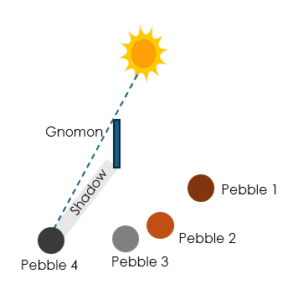
Plant a stick (gnomon) on flat ground. Locate the length of the shade throughout the day (by placing a small pebble on the tip of the shade, or by planting a small stick).
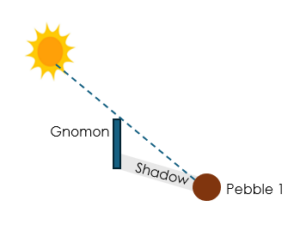 |
It is important to start these readings in the morning, so that you have the morning and the afternoon. Indeed, this ensures that the instant when the Sun is due South is included in the readings: this will determine North.
 |
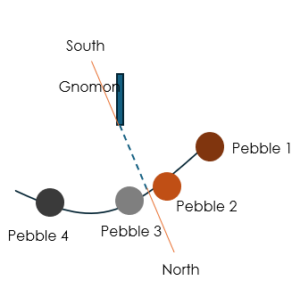 |
By tracing the curve that connects all the pebbles (or sticks) that have made it possible to identify the length of the shadow during the day, we locate the point closest to the gnomon. By definition, the time when the shadow was shortest is noon. Even if we didn’t have the chance to take a survey when it was precisely noon, the curve drawn allows us to extrapolate this point. On the line segment that connects this point of the curve to the gnomon, the gnomon gives the South and the point where the curve is closest to the gnomon corresponds to the North.
It’s very accurate, but a bit slow.
|
Finding North without a compass All articles |
||
|
1 |
With a stick (and the day) |
|
|
2 |
With a stick (and 30 minutes) |
|
|
3 |
With a regular watch |
|
|
4 |
With a pilot watch |
|
|
5 |
With a double sundial |
|