Warning: it is not known for sure whether this instrument was actually used by the Vikings. Such an instrument would have been made of wood (we’ll see why) and a small wooden instrument doesn’t keep well, especially in a maritime environment. Whether the Vikings had such an instrument is a point fiercely debated by specialists. A candidate, dated from the eleventh century, has been found.
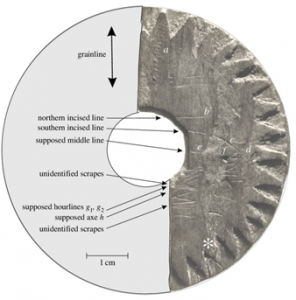
The Uunartoq disc Discovered in 1948 in the Uunartoq fjord in southwestern Greenland. On the right, the fragment of carved wood found in Greenland dated to the eleventh century. On the left, the explanations of the 2013 article interpreting this disc as a solar compass, whereas it was previously considered a fragment of a sundial. Warning: it could also be a confessional record, a mnemonic tool for navigation, or even a toy.
The instrument consists of a graduated disc in the center of which a gnomon is attached.
The principle of use is relatively simple but requires prior preparation on land before departure. The solar compass will remain correctly adjusted for about a fortnight, for a given latitude, which seems well suited for a Scandinavia-Iceland-Greenland crossing, or back. For other navigations, the Vikings probably sailed within sight of the coast.
Preparation: for a whole day, locate and mark on the dial the top of the gnomon’s shadow, when the compass is well placed horizontally. It is because the disc must be marked (written or engraved) and probably erased at the end of the journey in order to be able to mark it again, that the object, if it existed, must have been made of wood, or of light material. At the end of the day, the curve thus drawn allows you to know the North (see also “How to find the North without a compass“). So we mark the North on the edge of the instrument.
No need for advanced astronomical knowledge: if you don’t know the formulas to calculate the hyperbola corresponding to the trace of the gnomon tip for a given day and latitude, you just have to keep track of it during the day. This empirical curve is valid for a few days, for the latitude of the place where it is drawn.
Use: if you don’t stray too far from the date and latitude of preparation, the shadow of the gnomon traces more or less the same curve. All you have to do is turn the instrument to match the top of the gnomon’s shadow with the curve drawn. The North that we spotted during the preparation is the North. The difficulty on board a ship is to keep the level horizontal. Besides, of course, there must be enough sun for the gnomon to have a shadow.
In other words, for navigators, (1) it seems easier to spot the North Star at night and (2) the invention of the compass has changed everything. Invented in the ninth century in China, it was probably first used as a talisman, then as a navigational instrument in the eleventh century in China and then in Persia, before appearing “invented” in the twelfth century in Italy. It became completely established in the fifteenth century, after various technological innovations (mobile compass roses, appearance of rhumb lines on maps, etc.).
|
Other navigational instruments attributed to the Vikings |
|
How to sail at constant latitude? A “solar shade board” is proposed as a solution. It is a board also pierced with a gnomon, on which the height of the Sun at noon at the desired latitude has been identified. We draw a circle around the gnomon with a radius equal to the length of the shadow at noon. When sailing, the board is placed in a bucket, where it floats to ensure its horizontality. When the Sun is at its highest in the sky (around noon), if the shadow comes out of the circle, it means that we are too far North. If it is too small, we are too far South. Of course, if we know that it is noon, we also know where the North is and where the South is, which makes the use of the solar compass useless… |
|
How do you spot the Sun when the sky is cloudy? A “sunstone” is proposed as a solution. It is a crystal (Icelandic spar) that has the effect of polarizing light. In other words, you just have to rotate it to find the direction of the Sun in the clouds. Such a crystal was found in the wreck of a ship that sank in the sixteenth century. A little late for the Vikings. Such inventions would have remained secret? |